Split large APIs into smaller functional domains to reduce load concentration
When a single API handles too many operations or functional areas, all traffic flows into one codebase, one set of workers, and one runtime footprint.
This creates load concentration, which leads to:
- CPU spikes
- Slower response times
- Harder scaling
- Deployment risks (one bug affects everything)
- Low agility (one change → redeploy the entire API)
The solution is to decompose the API into smaller, domain-specific APIs following API-led connectivity and domain-driven design principles.
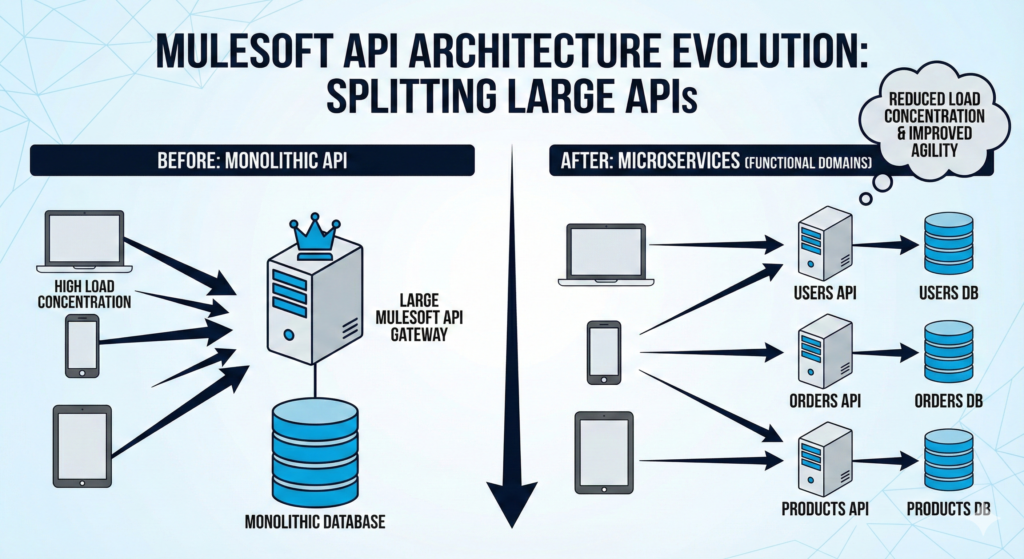
Example: Overloaded “Mega API”
Imagine a single API:/customer-management-api
It handles everything:
GET /customersPOST /customersGET /customers/{id}/ordersPOST /customers/{id}/ordersGET /customers/{id}/paymentsPOST /customers/{id}/validate-kycGET /customers/{id}/loyalty
Problems in this setup:
- High traffic endpoints (e.g., orders) strain the same worker pool as low-traffic endpoints (e.g., KYC)
- One spike in orders slows down unrelated domains like loyalty or payments
- Hard to scale — the only option is to scale everything together (expensive!)
- Deployment risk increases — a small update in KYC could break orders
- The API grows into a “god service,” making code unmaintainable
Optimized Architecture: Split Into Functional Domains
Break the mega API into smaller logical domains:
Domain APIs
/customer-profile-api/customer-order-api/customer-payment-api/customer-kyc-api/customer-loyalty-api
How this helps:
1. Balanced Load Distribution
Traffic spreads out across different APIs → each has isolated resources.
E.g.,
- Orders API can scale to 4 workers
- KYC API can stay at 1 worker
- Loyalty API can auto-scale independently
2. Better Scalability
Hot spots (order processing) can be scaled without increasing cost on low-traffic domains.
3. Increased Stability
One domain experiencing failure doesn’t impact the rest.
E.g., a loyalty system outage does NOT block payment operations.
4. Faster Deployments
Teams can deploy changes to individual domain APIs without touching others.
5. Improved Reusability
Other teams and systems can consume granular APIs more easily.
When to Apply This Tip
- When an API exceeds ~10–15 operations
- When multiple domains (payments, orders, customers) live inside one codebase
- When you notice CPU spikes on only one feature
- When deployments are becoming risky or slow
- When Anypoint Monitoring shows one operation consumed 80%+ of runtime
Connect with us
At Conscendo Technologies, The MuleSoft Integration Services Team specializes in delivering high-impact MuleSoft solutions that accelerate digital transformation. From API strategy to implementation and managed services, our team has deep expertise across the MuleSoft ecosystem. If you’re looking to modernize integrations or scale your API-led initiatives, reach out to us — we’re here to help you succeed.