DataWeave: A Modern Approach for data transformations
Let us continue from our previous blog Parsing JSON and XML in Salesforce Apex: Challenges and Why DataWeave Matters , Lets try discuss a new feature introduced by Salesforce. DataWeave (originally from MuleSoft) is a powerful transformation language designed specifically for:
- JSON <-> XML <-> CSV transformations
- Complex mappings
- Declarative data manipulation
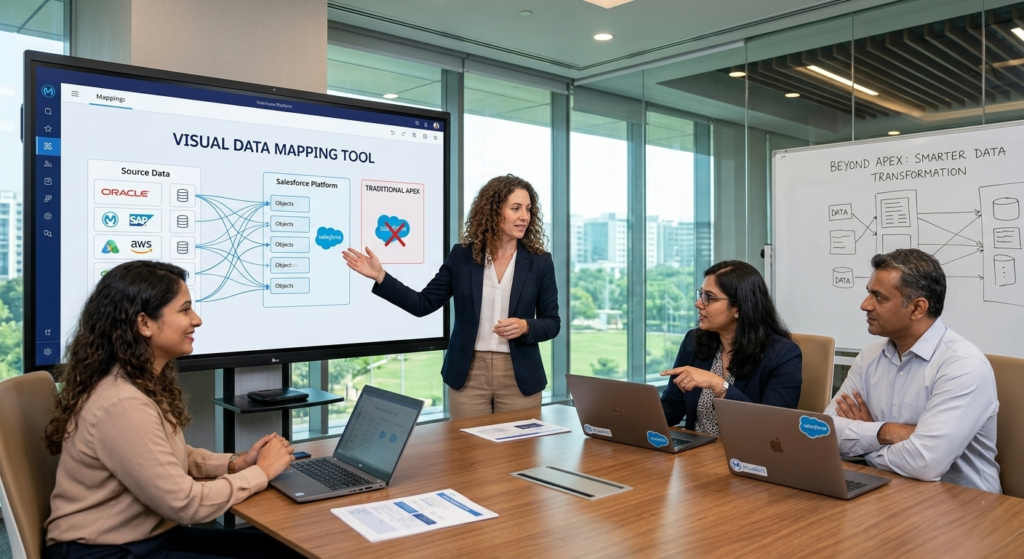
Why DataWeave in Salesforce?
With the introduction of DataWeave in Salesforce, developers can:
- Replace verbose parsing logic with concise scripts
- Handle complex nested data effortlessly
- Separate transformation from business logic
Example Comparison
Traditional Apex Transformation
Map<String, Object> input = (Map<String, Object>) JSON.deserializeUntyped(jsonString);

Map<String, Object> output = new Map<String, Object>();
output.put('fullName', input.get('name'));
output.put('userAge', input.get('age'));
DataWeave Equivalent (Conceptual)
%dw 2.0
output application/json
---
{
  fullName: payload.name,
  userAge: payload.age
}
Benefits of Using DataWeave
1. Declarative and Readable
- Focus on what, not how
- Easier for teams to understand
2. Built for Transformation
- Native support for JSON, XML, CSV
- Handles nested structures gracefully
3. Reduced Apex Complexity
- Less boilerplate code
- Cleaner separation of concerns
4. Resilient to Change
- Flexible mappings
- Easier updates when APIs evolve
5. Reusability
- Scripts can be reused across integrations
When Should You Consider DataWeave?
Use DataWeave when:
- Payloads are large or complex
- You need heavy transformation logic
- APIs frequently change
- You want cleaner, maintainable integration code
Stick with Apex parsing when:
- Payloads are simple
- Transformation needs are minimal
Conclusion
Parsing JSON and XML in Apex is straightforward for simple use cases, but quickly becomes cumbersome in real-world integrations. The limitations around maintainability, flexibility, and performance highlight a clear need for a better approach.
DataWeave fills this gap by offering a purpose-built, declarative way to handle data transformation—making integrations in Salesforce more scalable, maintainable, and future-proof.
If you’re working on complex integrations, it’s worth rethinking your approach:
Apex for logic, DataWeave for transformation.