Intelligent Document Processing with MuleSoft: Benefits, Limitations and Best Practices
Enterprises are drowning in document work—invoices, POs, claims, contracts, KYC forms, identity proofs. Traditional OCR helps you “read” the document, but the real business value comes from classifying, extracting the right fields, validating, routing, and integrating that data into ERP/CRM/RPA workflows. That end‑to‑end capability is exactly what MuleSoft Intelligent Document Processing (IDP) brings to the table.
This guide explains what MuleSoft IDP is, its advantages and limitations, a reference architecture, real‑world use cases, a build‑vs‑buy checklist, and implementation best practices—so you can decide how to fit IDP into your automation roadmap.
What is MuleSoft IDP—Really?
MuleSoft Intelligent Document Processing aka IDP is an Anypoint Platform capability that lets teams create “document actions” to extract structured data from unstructured or semi‑structured documents, publish those actions as APIs, and consume the results (usually in JSON) within Mule apps, RPA bots, Flow, or downstream systems. Each document action can define fields, tables, confidence thresholds, and human review steps when accuracy dips below your set level.
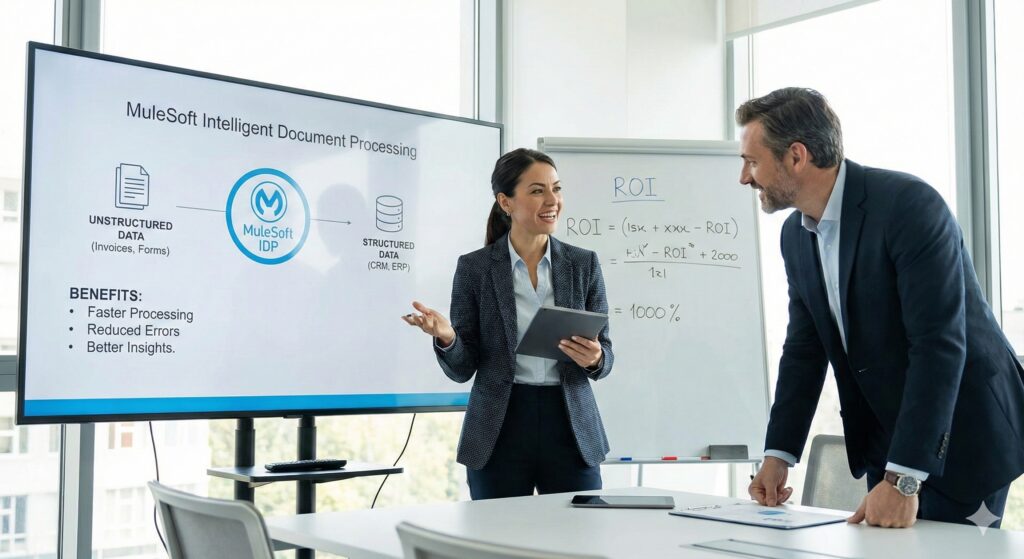
Recent releases add Einstein for IDP, enabling natural‑language prompts (e.g., “Extract the total amount after tax” or “Summarize the key obligations”) and access to multimodal LLMs (OpenAI GPT‑4o, Google Gemini) through the Salesforce Einstein Trust Layer—with model selection per prompt and explicit note that customer data isn’t used to train model
Why MuleSoft IDP Matters
- API‑Led, Reusable Building Blocks
- Einstein‑Powered Extraction, Classification & Summaries
- Human‑in‑the‑Loop for Accuracy & Compliance
- Tight Integration with Anypoint + RPA + Flow
- Templates for Common Documents
- Enterprise Security & Trust Controls
Where MuleSoft IDP Can Fall Short
- Advanced, Niche IDP Features May Require Adjacent Services
- Licensing & Cost Considerations
- Training & Operating Model
- Accuracy on Highly Unstructured Legalese
- Comparisons with Best‑of‑Breed IDP Vendors
Real‑World Use Cases & Examples
- Invoice Processing (AP Automation)
- Purchase Orders (Order Ops)
- Contracts & ID/KYC (Semi/Unstructured)
- Claims Processing (Insurance/FS)
Best Practices & Tips
- Go live fast with High-ROI, Semi‑Structured Docs; use pre‑built templates, then iterate on prompts.
- Engineer Prompts Thoughtfully, Be explicit: Choose models per prompt and optimize for cost/accuracy.
- Set Confidence Thresholds Per Field
- Apply stricter thresholds to amounts, dates, IDs; route low‑confidence to human review and capture feedback loops.
- Instrument for Observability
- Pair with RPA Where Needed
- Use MuleSoft RPA to interact with legacy UIs; let Process APIs remain the backbone for scale and governance.
- Benchmark Against Best‑of‑Breed
Next Steps:
At Conscendo Technologies, we specialize in delivering high-impact MuleSoft solutions that accelerate digital transformation. From API strategy to implementation and managed services, our team has deep expertise across the MuleSoft ecosystem. If you’re looking to modernize integrations or scale your API-led initiatives, reach out to us — we’re here to help you succeed.