Enterprise AI, APIs, Integrations, Agentic AI, and Modern Enterprise Architecture
1. Why Salesforce & MuleSoft Developers Must Learn AI
Enterprise software is rapidly shifting from:
- Traditional automation
to - Intelligent automation
to - Autonomous AI systems
Today’s enterprise platforms are embedding AI deeply into:
- CRM
- Integration
- Workflow automation
- Customer support
- Analytics
- Decision making
This makes AI knowledge essential for both:
- Salesforce professionals
- MuleSoft integration developers
2. Where Salesforce and MuleSoft Fit in Enterprise AI
| Platform | AI Role |
|---|---|
| Salesforce | AI-powered business applications |
| MuleSoft | AI integration & orchestration layer |
Together they form:
The operational brain + nervous system of enterprise AI.
3. Evolution of Enterprise Systems
| Era | Focus |
|---|---|
| 2000–2010 | Digitization |
| 2010–2020 | Cloud & APIs |
| 2020–2024 | Automation |
| 2024–2030 | AI Agents & Autonomous Enterprises |
We are now entering:
The Agentic AI Era
4. What is AI?
Artificial Intelligence (AI) refers to systems capable of:
- Understanding
- Learning
- Reasoning
- Generating
- Making decisions
AI systems simulate human-like intelligence.
5. Major Types of AI
| Type | Example |
|---|---|
| Machine Learning | Fraud detection |
| Deep Learning | Face recognition |
| Generative AI | ChatGPT |
| Conversational AI | Einstein Copilot |
| Agentic AI | Autonomous agents |
| Multi-Agent AI | Coordinated enterprise agents |
6. What is Generative AI?
Generative AI creates:
- Text
- Code
- Images
- Audio
- Documents
- Workflows
Examples:
- OpenAI GPT
- Claude
- Gemini
- Llama
7. What is an LLM?
LLM = Large Language Model
LLMs are trained on massive text datasets to:
- Understand language
- Generate responses
- Perform reasoning
- Create content
8. Popular Enterprise LLMs
| Model | Company |
|---|---|
| GPT-4 / GPT-5 | OpenAI |
| Claude | Anthropic |
| Gemini | |
| Llama | Meta |
| Bedrock Models | Amazon Web Services |
9. How LLMs Work
LLMs predict the next probable token based on context.
Core concepts:
- Tokens
- Transformers
- Attention mechanism
- Context windows
- Fine-tuning
10. What is Prompt Engineering?
Prompt engineering is designing effective AI instructions.
Example:
Weak Prompt
“Generate integration”
Better Prompt
“You are an enterprise integration architect. Generate a scalable MuleSoft integration architecture between Salesforce and SAP using event-driven APIs.”
11. Types of Prompting
| Prompt Type | Description |
|---|---|
| Zero-shot | No examples |
| One-shot | One example |
| Few-shot | Multiple examples |
| Chain-of-thought | Step-by-step reasoning |
| Role prompting | Assign a role |
| Structured prompting | JSON/XML outputs |
12. Example Salesforce Prompt
You are a Salesforce Solution Architect.

Design an Agentforce-based customer support solution integrating Service Cloud, MuleSoft APIs, and AWS Bedrock.
13. Example MuleSoft Prompt
You are a MuleSoft Enterprise Architect.

Design an API-led integration architecture exposing SAP, Oracle, and Salesforce services securely for AI agents.
14. What are Embeddings?
Embeddings convert text into vectors.
Purpose:
- Semantic understanding
- Similarity search
- AI memory
- Enterprise knowledge retrieval
15. Embedding Example
Text:
“Customer order failed”
Gets converted into vector representation:
[0.123, -0.784, 0.567 ...]Similar meanings generate nearby vectors.
16. What is a Vector Database?
Vector databases store embeddings.
Popular vector DBs:
- Pinecone
- Weaviate
- Chroma
- Milvus
- pgvector
17. Why Vector Databases Matter
Used for:
- Enterprise AI search
- AI assistants
- Knowledge retrieval
- Semantic search
- RAG systems
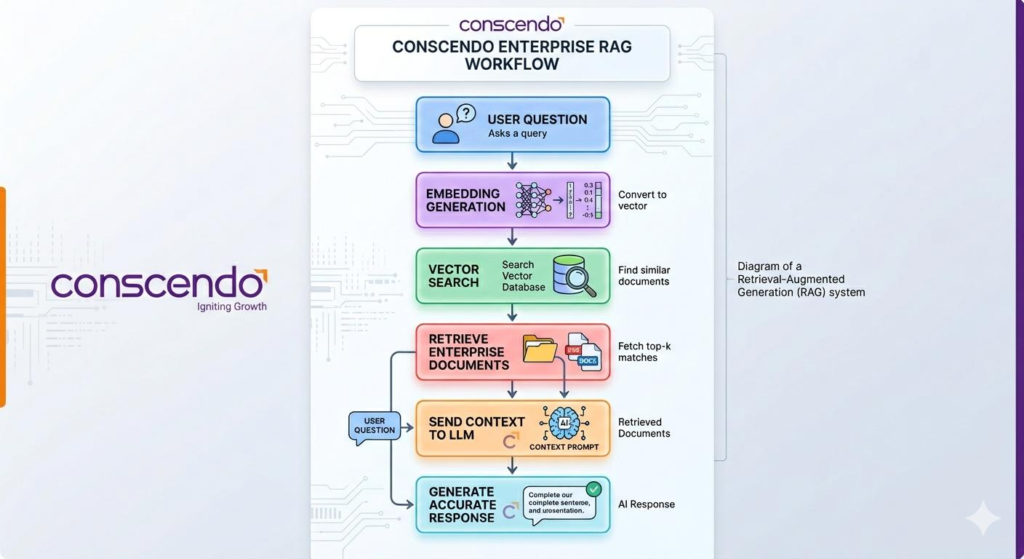
18. What is RAG?
RAG = Retrieval-Augmented Generation
One of the most important enterprise AI architectures.
RAG combines:
- LLM
- Enterprise knowledge
- Retrieval systems
19. RAG Flow
20. Why RAG is Essential
Without RAG:
- Hallucinations
- Outdated answers
- Generic responses
With RAG:
- Accurate enterprise answers
- Real-time knowledge
- Secure AI
- Domain-specific intelligence
21. Salesforce Example of RAG
User asks:
“Show my unresolved premium customer cases.”
AI retrieves:
- CRM records
- Case history
- SLA rules
- Customer tier
Then generates intelligent response.
22. MuleSoft Example of RAG
User asks:
“What is our SAP invoice escalation policy?”
MuleSoft retrieves:
- SAP documents
- SharePoint policies
- Confluence pages
- Knowledge base articles
Then AI answers accurately.
23. What are AI Agents?
AI agents are autonomous systems that:
- Understand goals
- Plan actions
- Use tools/APIs
- Execute tasks
- Coordinate workflows
24. Enterprise AI Agent Example
A customer support agent can:
- Read tickets
- Query Salesforce
- Invoke MuleSoft APIs
- Check SAP orders
- Trigger refunds
- Send notifications
Without human intervention.
25. Types of AI Agents
| Type | Example |
|---|---|
| Conversational Agent | Chatbots |
| Workflow Agent | HR onboarding |
| Autonomous Agent | Incident remediation |
| Multi-Agent Systems | Enterprise coordination |
26. What is Agentic AI?
Agentic AI refers to systems where AI:
- Makes decisions
- Executes workflows
- Uses tools autonomously
- Collaborates with other agents
This is the biggest enterprise AI trend of 2025–2026.
27. Salesforce Agentforce
Agentforce allows enterprises to build:
- AI agents
- Autonomous workflows
- AI-driven customer engagement
Capabilities include:
- CRM access
- Workflow automation
- Knowledge retrieval
- AI actions
28. MuleSoft’s Role in Agentic AI
MuleSoft provides:
- API connectivity
- Enterprise orchestration
- AI governance
- Secure system access
- Agent integrations
MuleSoft becomes the:
Action and orchestration layer for enterprise AI.
29. Why APIs Are Critical for AI
AI without APIs is isolated intelligence.
APIs allow AI to:
- Access data
- Trigger workflows
- Update systems
- Perform business actions
30. AI Needs Real-Time Integrations
AI systems require:
- CRM data
- ERP access
- Messaging systems
- Event streams
- Databases
- SaaS applications
This is why integration platforms become central to AI architecture.
31. API-Led Connectivity in AI
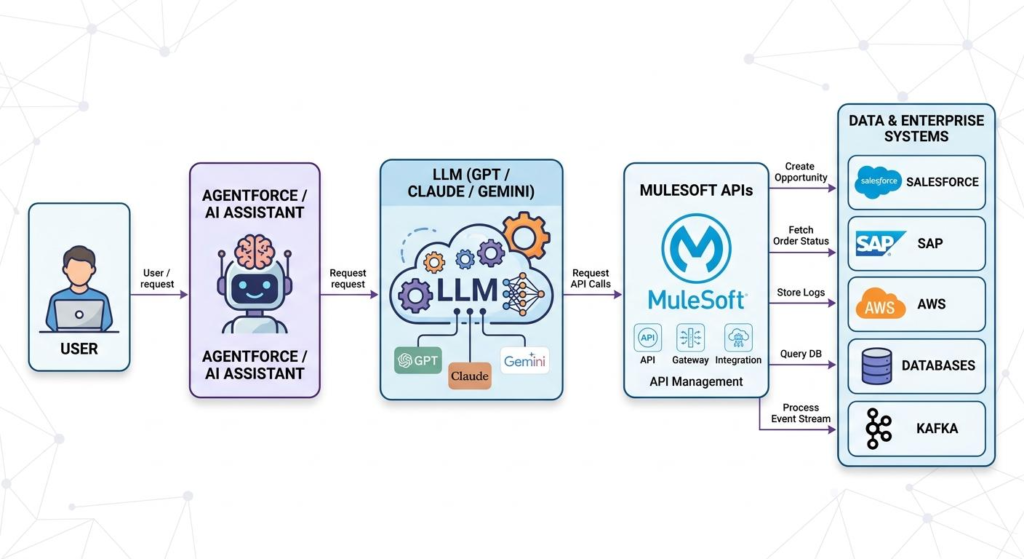
MuleSoft’s API-led approach is ideal for AI:
| Layer | AI Purpose |
|---|---|
| Experience APIs | AI channels |
| Process APIs | AI orchestration |
| System APIs | Backend access |
32. Example Enterprise AI Architecture
33. Salesforce AI Ecosystem
Einstein AI
AI capabilities embedded into Salesforce.
Features:
- Predictive AI
- Generative AI
- AI scoring
- AI recommendations
Einstein Copilot
Conversational enterprise AI assistant.
Agentforce
AI agents for autonomous enterprise workflows.
Data Cloud
Unified enterprise data for AI grounding.
34. MuleSoft AI Ecosystem
MuleSoft AI Chain
AI orchestration framework.
AI Connectors
Connectors for:
- OpenAI
- Bedrock
- Vertex AI
- Vector DBs
MCP Support
Expose APIs as AI-ready tools.
Agent Fabric
Multi-agent orchestration and governance.
35. What is MCP?
MCP = Model Context Protocol
A standard for AI agents to:
- Discover APIs
- Use enterprise tools
- Interact securely
36. Why MCP Matters
Without MCP:
- Hardcoded integrations
- Poor interoperability
With MCP:
- Standardized AI access
- Faster enterprise AI development
- Secure AI ecosystems
37. Salesforce + MuleSoft + AI
This combination is becoming extremely powerful.
Salesforce Provides
- Business context
- CRM intelligence
- Customer workflows
MuleSoft Provides
- Enterprise connectivity
- Orchestration
- Governance
- Secure integrations
Together:
They enable enterprise-grade autonomous AI systems.
38. Enterprise AI Use Cases
AI Customer Support
- Agentforce agents
- Automated case handling
- Intelligent escalation
AI Sales Assistant
- Opportunity recommendations
- AI-generated emails
- Lead scoring
AI-Powered Integrations
- Intelligent routing
- Error resolution
- Automated retries
Intelligent Document Processing
- OCR
- Invoice extraction
- AI classification
AI Incident Management
- Auto-remediation
- Ticket creation
- Root cause analysis
39. Security Challenges in Enterprise AI
Major concerns:
- Hallucinations
- Data leakage
- Prompt injection
- Unauthorized access
- Compliance violations
40. Why MuleSoft Helps Secure AI
MuleSoft provides:
- API governance
- Authentication
- Authorization
- Policy enforcement
- Monitoring
- Audit trails
Critical for enterprise AI production systems.
41. Why Salesforce Helps Secure AI
Salesforce provides:
- Trust Layer
- Data masking
- Secure grounding
- Access control
- Responsible AI framework
42. Observability in AI Systems
Modern AI requires:
- Monitoring
- AI tracing
- Cost tracking
- Latency monitoring
- Agent observability
43. Skills Salesforce Developers Should Learn
AI Skills
- Prompt engineering
- Einstein AI
- Agentforce
- Data Cloud
- AI workflows
Architecture Skills
- API integration
- Event-driven architecture
- AI governance
- Enterprise security
44. Skills MuleSoft Developers Should Learn
AI Integration Skills
- AI connectors
- RAG pipelines
- MCP
- Vector DB integrations
- Event streaming
Architecture Skills
- AI orchestration
- Multi-agent systems
- Zero-trust APIs
- AI governance
45. Future Roles Emerging
| Role | Description |
|---|---|
| AI Integration Engineer | AI + APIs |
| Agentic Architect | AI workflow architecture |
| Enterprise AI Architect | End-to-end AI systems |
| AI Platform Engineer | AI infrastructure |
| AI Automation Architect | Autonomous workflows |
46. Key Takeaways
| Concept | Importance |
|---|---|
| LLMs | AI reasoning engine |
| Prompts | AI instruction mechanism |
| Embeddings | Semantic understanding |
| Vector DBs | Enterprise knowledge retrieval |
| RAG | Accurate enterprise AI |
| AI Agents | Autonomous execution |
| MCP | Standardized AI interoperability |
| APIs | Enterprise AI action layer |
| Salesforce | Business AI platform |
| MuleSoft | AI orchestration platform |
47. Final Summary
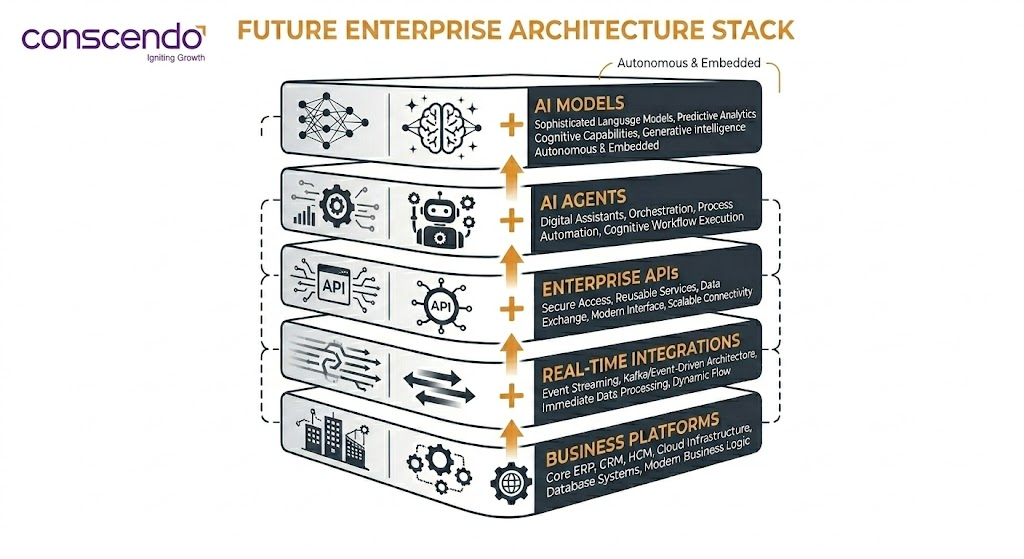
The future enterprise architecture stack is becoming:
Salesforce brings:
- Business intelligence
- Customer workflows
- AI-powered CRM
MuleSoft brings:
- Connectivity
- Orchestration
- Governance
- Enterprise AI enablement
Together they form: