Agentforce-in-Action (3)For the past few years, enterprise AI has mostly been about conversation ; answering questions, summarizing documents, drafting content. Useful, but passive. The system tells you what to do, and a person still has to go do it. That’s changing fast, and Salesforce’s Agentforce platform is one of the clearest signals of where things are headed: AI that doesn’t just advise, but acts.
Agentforce isn’t another chatbot bolted onto the CRM. It’s a platform for building autonomous AI agents that understand what a business is trying to accomplish, reason through the steps required to get there, pull in trusted company data, and then actually execute the work ; inside Salesforce, within the boundaries an administrator has defined. Think of it less like a search assistant and more like a new hire who already knows your systems, never gets tired of repetitive tasks, and checks in with a human whenever a decision calls for judgment.
Understanding AI Agents: The Fundamentals -draft to delete
Before getting into what Agentforce does specifically, it helps to step back and look at how AI agents work as a category. Stripped down to its core, an agent sits between two forces: a degree of human control and oversight, and a degree of autonomous action it can take on its own. What allows it to operate in that space is a small set of capabilities working together ; memory to retain context across a conversation, reactivity to respond to changes in its environment, and access to tools such as APIs, the internet, and code interpretation that let it actually do something rather than just talk about it. Humans delegate tasks into this loop, and the agent draws on its environment and tool access to carry them out.
Not every agent is built the same way, and the differences matter for what you can reasonably expect one to handle. Simple reflex agents react to a given input with a fixed response and nothing more. Model-based reflex agents keep an internal picture of their environment so they can react more intelligently to change. Goal-based agents plan a sequence of actions toward a defined outcome, while utility-based agents go a step further and weigh multiple possible outcomes to pick the best one. Learning agents sit on top of all of this, improving their own performance over time based on feedback and experience.
These building blocks get deployed in a few different system patterns. A single agent acts much like a personal assistant, handling a defined scope of tasks for one user or process. A multi-agent system has several agents interacting with each other, dividing up work and collaborating toward a shared goal. And a human-machine pattern keeps a person directly in the loop, with the agent providing assistance rather than acting fully independently. Agentforce draws on all three patterns depending on the use case ; a single agent handling routine service requests, multiple agents collaborating across Sales and Service, or a human approving an agent’s recommendation before it goes out.
How AI agents work, the main agent types, and the three system architecture patterns.
What Is Agentforce, Exactly?
Agentforce is Salesforce’s platform for building autonomous AI agents that support employees and customers across Sales, Service, Marketing, Commerce, and other core business functions. What sets it apart from the automation most teams already have in place is the ability to understand a natural language request, analyze the surrounding business context, pull relevant CRM data on its own, decide what the appropriate next action actually is, and then carry that action out ; all inside guardrails an administrator has explicitly approved.
None of that replaces the people already doing this work. It absorbs the high-volume, low-judgment parts of the job so they don’t have to, freeing up time for the parts of the role that genuinely benefit from a human’s attention.
Automation Got Us Here. Reasoning Is What Comes Next.
Most organizations already lean on Salesforce Flow, Process Builder, or Apex to keep repetitive work off people’s plates. That automation is valuable, but it’s rigid by design ; it follows the exact rules it was given, nothing more. If a situation falls outside those rules, it stalls, and a person has to step in.
Agentforce builds on top of that foundation rather than replacing it, and the difference comes down to one thing: reasoning. A traditional workflow asks, “Which predefined process should fire?” An Agentforce agent asks something closer to what a capable employee would ask ; “What is this person actually trying to accomplish, and what’s the best sequence of steps to get them there, given everything I know about this account?”
Traditional automation follows rules. Agentforce agents understand intent and adapt.
That shift, from rule-following to goal-understanding, is what allows an agent to handle the messy, non-linear requests that used to require a human to untangle.
What Actually Happens Behind the Scenes
When someone makes a request of an Agentforce agent, four things happen in sequence, usually within seconds.
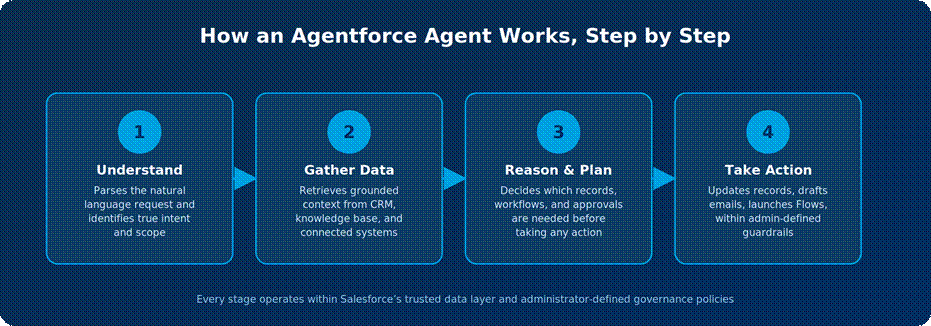
The four-stage Agentforce reasoning cycle: understand, gather, plan, act.
Understand. The agent has to figure out what’s actually being asked. A request like “show me customers with open opportunities worth over $100,000 and draft follow-up emails” sounds simple, but the agent has to correctly parse intent, scope, and the implied next step ; not just the surface-level query.
Gather trusted data. The agent goes looking for answers only in places it’s allowed to look: Salesforce CRM records, internal knowledge articles, customer history, connected external systems, and business metadata. It isn’t drawing on general internet knowledge ; it’s grounded entirely in the organization’s own operational data.
Reason and plan. With that context in hand, the agent decides which records need to be touched, whether the action requires a manager’s sign-off, and whether a human absolutely needs to be looped in before anything happens.
Take action. Only after working through the plan does the agent execute ; updating a record, opening a case, kicking off a Flow, drafting a message, scheduling a follow-up, or surfacing a recommendation for a rep to approve. Every one of those actions happens inside the guardrails an administrator has already set.
Inside the Architecture
Zooming into the technical layer helps explain why the four-stage cycle feels so responsive. When a client interacts with the agent, the request first passes through topic classification, where an LLM interprets the utterance and guardrails confirm the topic is one the agent is actually permitted to handle. From there, the relevant actions for that topic are pre-filtered, the prompt is assembled with the right instructions and conversation history, and the model decides whether to respond directly or invoke an action.
If action is required, the agent hands off to deterministic logic ; Apex, Flow, or an API call ; or to a retrieval step that pulls grounded context through RAG before generating a response. The result feeds back into what Salesforce calls the action loop: the agent re-evaluates the plan with the new information now available, and either takes another action or responds to the user. This loop is what allows a single request to resolve into a multi-step task without a human manually chaining each step together.
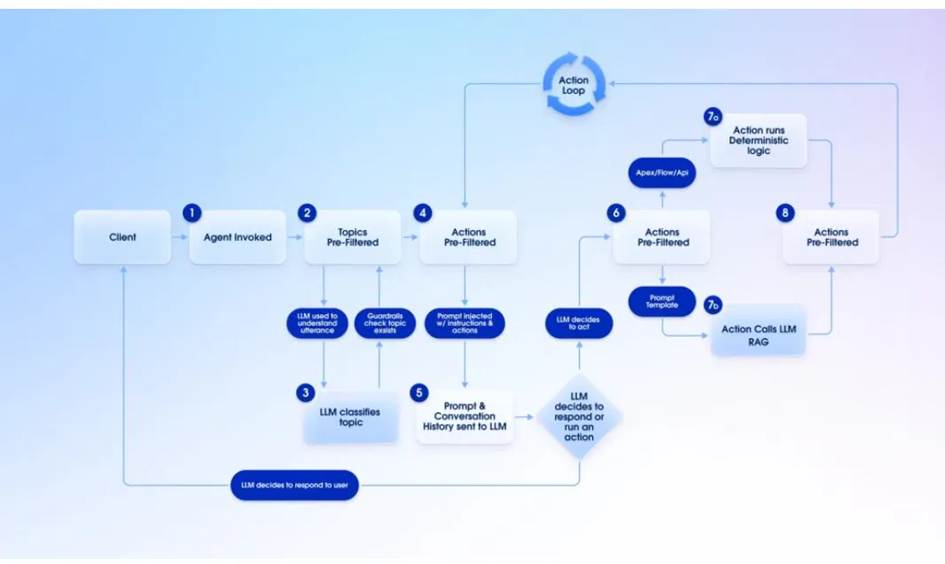
Request routing, reasoning, and the action loop that closes the cycle.
Meeting Customers Across Every Channel
An agent is only as useful as the places customers and employees can actually reach it. Agentforce is designed to sit behind whichever channel a conversation starts in ; email, web and mobile chat, Slack or Teams, voice ; and route every one of those conversations through the same reasoning and trust layer. That matters because it means a customer who starts a conversation over chat and follows up by phone gets a consistent answer both times, grounded in the same CRM records, the same Flows and connected APIs, and the same knowledge base.
It also means the integration work happens once, at the hub, rather than being rebuilt separately for every channel a business wants to support.
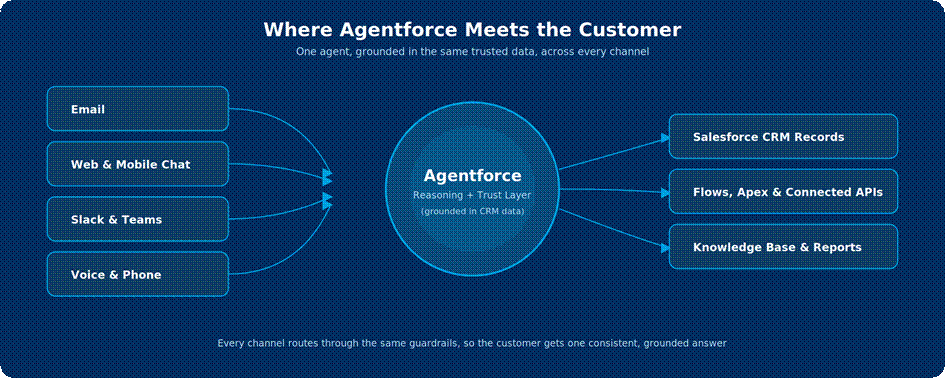
One agent, grounded in the same trusted data, across every channel.
Where This Is Already Paying Off
The value of this becomes a lot clearer when you look at how it plays out inside specific industries, rather than in the abstract.
Agentforce is already at work across financial services, healthcare, retail, manufacturing, telecom, and B2B sales.
Financial services. Take commercial lending. A relationship manager at a regional bank asks a simple question ; which applications in my pipeline are ready to move to underwriting? Instead of a coordinator spending half a day cross-checking financial statements against loan files by hand, the agent does it in minutes: flagging incomplete applications, automatically emailing the client for the missing documents, and routing everything that’s ready straight into the underwriting queue, with a full audit trail preserved for compliance along the way.
Healthcare payer operations. The stakes are different but the pattern holds. A care coordinator checking on a prior-authorization request doesn’t have to dig through a case file manually. The agent pulls it up, checks it against the clinical policy criteria stored in Health Cloud, and ; this is the important part ; knows the difference between a routine gap it can resolve on its own, like following up on a missing diagnostic code, and an urgent case that needs a clinician’s eyes before anything moves forward.
Retail and e-commerce. During peak shopping periods, a national retailer’s service team fields thousands of nearly identical questions: where’s my order, can I change the delivery address. An Agentforce agent verifies the customer, checks live carrier tracking, determines whether the shipment can still be redirected under fulfillment-center rules, and either makes the change on the spot or hands it to a live agent if it’s too late.
Manufacturing. Field service technicians are seeing something closer to a co-pilot. Before a technician even arrives on-site to fix a malfunctioning packaging line, the agent has already pulled the equipment’s full service history, matched the reported fault code to the manual, suggested a likely root cause, and checked whether the right spare parts are already in the technician’s van.
Telecommunications. Providers are using the same underlying capability for churn prevention. Instead of running retention campaigns once a month, an agent can watch for early warning signs in usage data, segment an at-risk customer into the right retention cohort, and draft a personalized offer immediately ; while still routing anything above a certain discount threshold to a manager for approval.
B2B sales. A rep can simply ask which enterprise accounts above a certain deal size have gone quiet for two weeks, and get back not just a list, but drafted, context-aware check-in emails ready to send, plus a flag on any account where the internal champion seems to have gone silent ; often the earliest sign a deal is at risk.
A related pattern shows up earlier in the sales cycle, too. Deal-relevant signals rarely live in one place ; they’re scattered across email threads, meeting notes, and private Slack conversations, and reps don’t always have time to log everything back into the CRM by hand. An agent can sit across those sources, extract and structure the relevant signals in near real time, and auto-update the CRM fields and pipeline summaries itself.
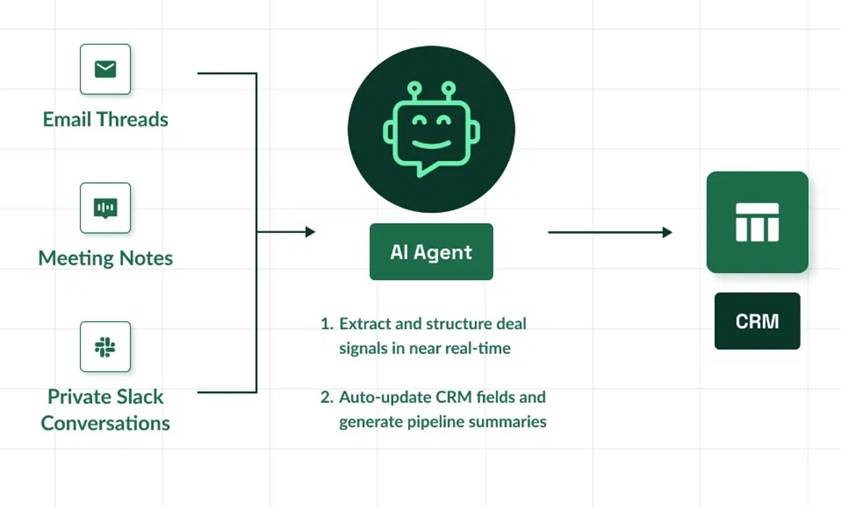
An agent extracting deal signals from email, meeting notes, and Slack, then auto-updating the CRM.
The Trust Question
Every one of those examples only works if the underlying data and governance are solid, and that’s usually the first concern that comes up in these conversations. Salesforce’s answer is to ground every agent response in an organization’s own trusted data rather than general model knowledge, and to enforce that through platform-level controls administrators set themselves. Which data an agent can see, which actions it’s allowed to take on its own, and where a human has to sign off ; all of that is defined explicitly, not left to the model’s discretion.
Every agent action passes through data permissions, action scope, human sign-off thresholds, and an audit trail.
What Organizations Are Actually Gaining
The pattern across every one of these use cases is the same:
Faster response times, less manual effort, and better data ; the recurring pattern across every use case.
But the bigger shift is structural ; it’s the ability to scale operations without scaling headcount at the same rate. That’s a different kind of growth than most teams are used to planning for.
Starting Small, on Purpose
The organizations getting the most out of this aren’t the ones rolling it out everywhere at once. They’re picking one clearly scoped process, making sure the underlying CRM data is actually clean before the agent starts relying on it, and being explicit up front about what the agent can and can’t do without a human’s approval.
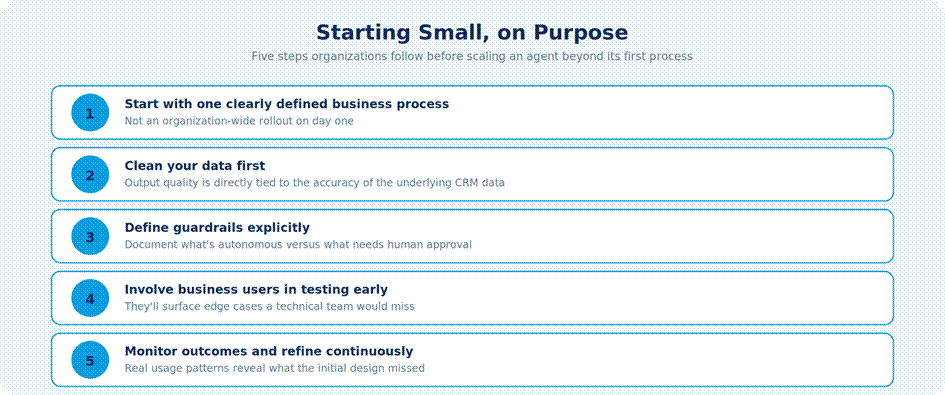
Getting this right has as much to do with process discipline as it does with the technology itself.
Where This Is Headed
AI inside Salesforce is moving from something that assists people to something that works alongside them. As organizations get more comfortable letting agents handle routine decisions autonomously, the day-to-day operational load on employees keeps shrinking ; not because the work disappears, but because it no longer needs a person attached to every step of it. What’s left is the work that actually benefits from a human doing it: strategy, judgment calls, and the relationships that data alone can’t manage.
That’s the real promise here. Not automation for its own sake, but a CRM that reasons alongside the people using it, working from the same trusted data they’d use themselves.
Key Takeaways
-
- Agentforce brings autonomous AI agents natively into the Salesforce platform.
-
- Agents understand requests, reason using trusted business data, and execute approved actions within defined guardrails.
-
- Sales, Service, Marketing, and Field Service teams across industries ; from banking to healthcare to manufacturing ; are already using agents to cut manual work and speed up decisions.
-
- Success depends on clean data, clear governance, and well-scoped use cases, not just deploying the technology.
-
- The goal isn’t AI replacing people ; it’s AI working alongside people to produce better outcomes, faster.
“The best AI doesn’t replace your workforce ; it amplifies it. Agentforce empowers employees by automating routine work while keeping people in control of the decisions that matter most.”