Top MuleSoft Trends to Watch in 2026
The Rise of AI-Driven Integration and the Future of Enterprise Connectivity
By Mahesh Raja Vandyala
The role of integration platforms has evolved dramatically over the past decade. What began as middleware connecting systems has transformed into a strategic layer that powers digital transformation.
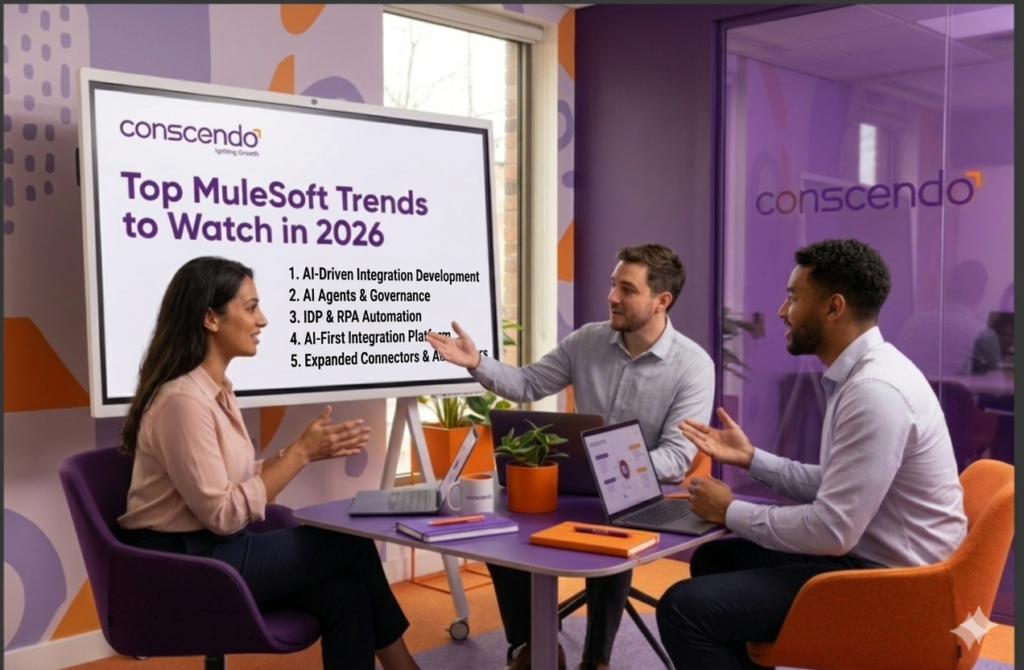
In the modern enterprise, applications, data, AI models, and automation tools must work together seamlessly. This is where integration platforms like MuleSoft play a crucial role. As organizations adopt AI, automation, and composable architectures, the demand for intelligent connectivity continues to grow.
2026 marks a turning point for MuleSoft and the broader integration ecosystem. The platform is evolving beyond traditional API-led connectivity into an intelligent orchestration layer for APIs, data, automation, and AI agents.
For enterprises investing in digital transformation, understanding these trends will be essential for building scalable, future-ready integration architectures.
Let’s explore the top MuleSoft trends shaping enterprise integration in 2026.
1. AI-Driven Integration Development
One of the most transformative trends in the MuleSoft ecosystem is the rise of AI-assisted integration development.
Traditional integration development often involves repetitive tasks such as mapping fields, configuring connectors, defining transformations, and writing orchestration logic. With the emergence of generative AI capabilities embedded in developer tools, much of this work is now being accelerated.
AI-assisted development allows developers to generate integration flows using natural language prompts. Instead of manually creating every component, developers can describe the integration requirement and receive a generated flow as a starting point.
For example, a developer could describe:
“Create an API that retrieves customer data from Salesforce and enriches it with order data from SAP.”
AI-powered tooling can then generate the base integration flow, connectors, and mappings.
This does not eliminate the role of developers. Instead, it allows them to focus on higher-value activities such as:
- Architecture design
- Governance enforcement
- Performance optimization
- Security and compliance
As AI-assisted development matures, integration teams will experience significant productivity gains, reducing development timelines and accelerating innovation.
2. The Rise of AI Agents and Agent Governance
Another emerging trend is the rise of AI agents capable of performing autonomous tasks.
These agents can interact with APIs, execute workflows, analyze data, and complete business processes with minimal human intervention. As enterprises begin deploying hundreds or even thousands of AI agents, managing their interactions becomes critical.
This is where MuleSoft’s emerging Agent Fabric architecture comes into play.
Agent Fabric provides a framework to:
- Discover AI agents across enterprise ecosystems
- Connect agents to enterprise systems via APIs
- Monitor agent activity and behavior
- Enforce governance policies
In many ways, this mirrors the evolution of API management a decade ago. As APIs proliferated across organizations, governance frameworks became necessary to ensure consistency, security, and compliance.
Similarly, as AI agents become part of enterprise operations, organizations will need Agent Governance.
Integration platforms like MuleSoft will become the central layer that enables AI agents to safely interact with enterprise systems.
3. Intelligent Automation with IDP and RPA
Automation has long been a focus area for digital transformation initiatives. However, traditional automation often required structured inputs and predefined workflows.
Today’s enterprises deal with vast amounts of unstructured data — invoices, contracts, forms, emails, and documents. Extracting actionable information from these sources has historically required manual effort.
MuleSoft’s Intelligent Document Processing (IDP) capabilities address this challenge by combining AI with automation.
IDP uses machine learning models to extract structured data from documents such as PDFs or scanned images. Once the data is extracted, MuleSoft can orchestrate downstream processes through APIs and integrations.
When combined with Robotic Process Automation (RPA), organizations can automate end-to-end processes that previously required human intervention.
For example:
- An invoice arrives via email
- IDP extracts key details such as vendor name and invoice amount
- MuleSoft APIs validate the data against ERP systems
- RPA updates the financial system
- The workflow triggers payment processing
This type of intelligent automation significantly reduces operational overhead while improving accuracy and efficiency.
Industries such as finance, healthcare, insurance, and logistics are already seeing substantial benefits from this approach.
4. The Emergence of an AI-First Integration Platform
Integration platforms are no longer just about connecting systems.
They are becoming the orchestration layer for AI-driven enterprises.
MuleSoft is increasingly positioned as a central component within the broader Salesforce ecosystem, working alongside platforms such as:
- Data Cloud
- Tableau
- Einstein AI
- Customer 360 applications
This architecture creates an Intelligent Integration Fabric, where APIs, data, AI models, and automation tools work together seamlessly.
In this model:
- MuleSoft provides connectivity and orchestration
- Data Cloud unifies enterprise data
- AI models generate insights and predictions
- Automation tools execute workflows
This convergence allows organizations to build intelligent systems that can respond dynamically to real-time data and business events.
As enterprises continue investing in AI-driven capabilities, the importance of integration platforms will only grow.
5. Expansion of Pre-Built Connectors and Accelerators
Another important trend shaping the MuleSoft ecosystem is the continued expansion of pre-built connectors and accelerators.
Enterprises today rely on hundreds of SaaS applications and enterprise platforms. Connecting these systems quickly and reliably is a major challenge for integration teams.
MuleSoft addresses this challenge through its growing ecosystem of connectors and templates.
These connectors allow organizations to integrate systems such as:
- ERP platforms
- CRM systems
- financial applications
- marketing automation tools
- industry-specific platforms
The increasing availability of pre-built connectors dramatically reduces development time. Instead of building integrations from scratch, teams can configure connectors and focus on business logic.
This approach supports the broader trend toward composable architecture, where enterprises assemble solutions from reusable components rather than building everything from the ground up.
6. Governance and Compliance at Scale
As integration ecosystems grow, governance becomes a critical concern.
Enterprises now manage hundreds or even thousands of APIs, integrations, and automation workflows. Without proper governance, this complexity can quickly lead to security risks, operational issues, and compliance challenges.
MuleSoft continues to enhance its governance capabilities through:
- API governance frameworks
- automated policy enforcement
- centralized monitoring dashboards
- compliance tracking tools
These capabilities help organizations enforce standards across their integration landscape.
In 2026, governance will extend beyond APIs to include AI agents, automation workflows, and data integrations.
Organizations will increasingly adopt platform governance models, where integration standards are enforced automatically through policy-driven frameworks.
This ensures that innovation can occur rapidly while maintaining enterprise security and compliance requirements.
7. Observability and Integration Intelligence
As integration ecosystems become more complex, visibility becomes essential.
Integration failures, latency issues, and performance bottlenecks can have significant business impact if not detected quickly.
MuleSoft is investing heavily in observability and integration intelligence to address this challenge.
Advanced monitoring capabilities allow organizations to:
- track API usage and performance
- detect anomalies in integration flows
- monitor system dependencies
- identify potential failures before they impact users
By leveraging telemetry data and AI-driven insights, integration teams can proactively manage their ecosystems rather than reacting to issues after they occur.
This shift toward predictive operations will be a key focus area for integration platforms in the coming years.
8. The Growth of Integration Centers of Excellence
As integration becomes a strategic capability, many organizations are establishing Integration Centers of Excellence (CoE).
These teams are responsible for:
- defining integration architecture standards
- managing reusable assets and accelerators
- enforcing governance frameworks
- enabling developer productivity
MuleSoft’s API-led connectivity model aligns closely with this approach. By organizing integrations into system APIs, process APIs, and experience APIs, organizations can create reusable building blocks that accelerate development across teams.
In 2026, successful enterprises will treat integration not as a project but as a core organizational capability.
This will require investments in governance, architecture standards, and developer enablement.
Final Thoughts: MuleSoft as the Enterprise Connectivity Backbone
APIs remain essential, but the scope of integration platforms is expanding to include:
- AI agents
- automation workflows
- enterprise data platforms
- event-driven architectures
- intelligent document processing
MuleSoft is evolving to address this broader vision.
Rather than serving solely as an API management platform, it is becoming the enterprise connectivity backbone that enables intelligent, automated, and AI-driven business operations.
Organizations that invest in modern integration strategies today will be better positioned to unlock the full potential of AI, automation, and composable architectures in the future.
As we look ahead to 2026, MuleSoft will play a pivotal role in enabling the next generation of digital enterprises.
The key trends shaping this evolution include:
- AI-assisted integration development
- the rise of AI agents and agent governance
- intelligent automation with IDP and RPA
- AI-first integration architectures
- expansion of connectors and accelerators
- stronger governance and observability frameworks
- the growth of integration centers of excellence
For technology leaders and architects, the message is clear:
Integration is no longer just about connecting systems.
It is about orchestrating the entire digital enterprise.
And MuleSoft is positioned to be at the center of that transformation.