Introduction
Artificial Intelligence is no longer limited to answering questions or generating content. The next phase of enterprise AI is action-oriented intelligence, AI that doesn’t just recommend the next step but actually performs it.
This is where Salesforce Agentforce changes the conversation.
Rather than acting as another chatbot, Agentforce enables organizations to build intelligent AI agents capable of understanding business context, reasoning through tasks, retrieving trusted information, and executing approved actions within Salesforce. These agents work alongside employees, helping teams become more productive while delivering faster and more personalized customer experiences.
What is Agentforce?
Agentforce is Salesforce’s platform for building autonomous AI agents that can assist employees and customers across Sales, Service, Marketing, Commerce, and other business functions.
Unlike traditional automation, which follows predefined rules, AI agents can:
- Understand natural language requests
- Analyze business context
- Retrieve relevant CRM information
- Decide the next appropriate action
- Execute workflows within defined business guardrails
Think of Agentforce as a digital teammate—not one that replaces people, but one that handles repetitive work so employees can focus on high-value activities.
From Automation to Intelligent Action
Many organizations already use Salesforce Flow, Process Automation, or Apex to automate repetitive tasks.
Agentforce builds on these capabilities by adding reasoning.
| Traditional Automation | Agentforce AI Agents |
|---|---|
| Follows fixed rules | Understands intent |
| Executes predefined steps | Plans multiple actions |
| Limited flexibility | Adapts based on context |
| Trigger-based | Conversation-driven |
| Requires manual decision-making | Assists with decisions before taking approved actions |
Instead of asking:
“What workflow should I run?”
An AI agent asks:
“What is the user’s goal, and what is the best sequence of actions to achieve it?”
How AI Agents Work Inside Salesforce


A typical Agentforce workflow includes four key stages:
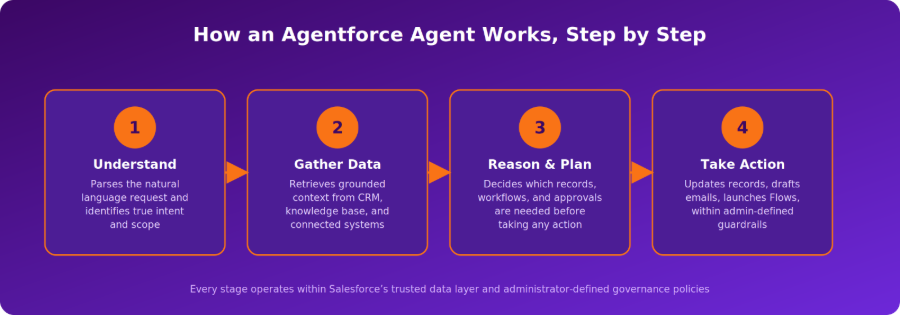
1. Understand the Request
The user interacts with the AI using natural language.
Example:
“Show me customers with open opportunities worth over $100,000 and draft follow-up emails.”
2. Gather Trusted Information
The agent securely retrieves information from:
- Salesforce CRM
- Knowledge articles
- Customer history
- External connected systems
- Business metadata
This helps ensure responses are grounded in organizational data rather than generic AI knowledge.
3. Reason and Plan
Instead of responding immediately, the AI determines:
- Which records to access
- Which workflows to trigger
- Whether approvals are needed
- Whether human intervention is required
4. Take Action
The AI can then:
- Update records
- Create cases
- Launch Salesforce Flows
- Draft emails
- Schedule follow-ups
- Recommend next best actions
All actions occur within administrator-defined permissions and governance policies.
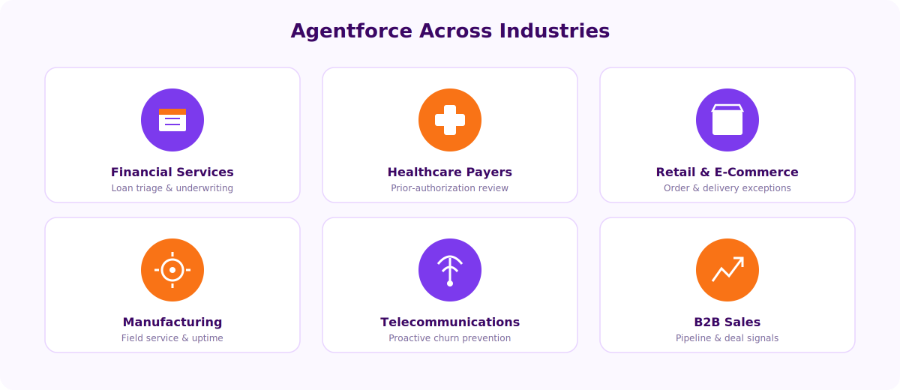
Real-World Business Use Cases
Sales Teams
Sales representatives spend significant time on administrative tasks.
An AI sales agent can:
- Qualify inbound leads
- Summarize customer interactions
- Recommend next-best actions
- Prepare meeting briefs
- Draft personalized emails
- Schedule follow-ups
Result:
Sales teams spend more time selling and less time updating CRM.
Customer Service
Imagine a customer asking:
“Where is my order, and can I change the delivery address?”
Instead of routing the request through multiple agents, an AI agent can:
- Verify customer identity
- Locate the order
- Check shipment status
- Update delivery details (if eligible)
- Confirm the change instantly
This reduces wait times while allowing human agents to focus on more complex cases.
Marketing Teams
Marketing teams can use AI agents to:
- Generate campaign ideas
- Segment audiences
- Analyze campaign performance
- Recommend content improvements
- Personalize customer journeys
Instead of spending hours compiling reports, marketers receive actionable insights in minutes.
Field Service
Field technicians can receive AI-generated guidance including:
- Previous service history
- Equipment manuals
- Recommended repair steps
- Required spare parts
This improves first-time fix rates and reduces service delays.
Why Trust Matters
One of the biggest concerns around enterprise AI is data security.
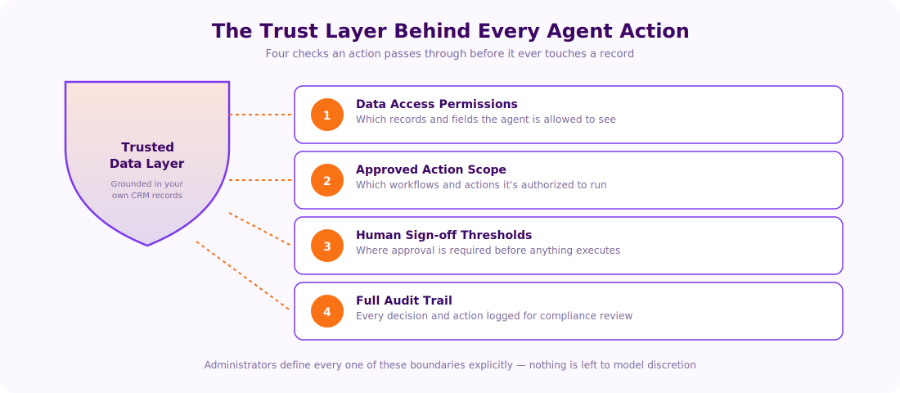
Salesforce addresses this by grounding AI responses in trusted enterprise data and enforcing governance through platform controls. Organizations can define permissions, approved actions, and policies so AI agents operate within established boundaries rather than acting without oversight.
Benefits Organizations Can Expect
Organizations adopting AI agents can experience benefits such as:
✅ Faster customer response times
✅ Reduced manual effort
✅ Improved employee productivity
✅ Better data consistency
✅ Higher customer satisfaction
✅ Smarter decision-making
Most importantly, AI agents help teams scale their operations without simply adding more manual work.
Best Practices Before Getting Started
To maximize value from Agentforce:
- Start with one clearly defined business process.
- Ensure CRM data is accurate and up to date.
- Define guardrails for what the AI can and cannot do.
- Involve business users in testing.
- Monitor outcomes and refine agent behavior over time.
Successful AI adoption is as much about process and governance as it is about technology.
Looking Ahead
AI in Salesforce is evolving from assisting users to collaborating with them. As organizations become more comfortable with autonomous workflows, AI agents will increasingly handle routine tasks, freeing employees to focus on creativity, strategy, and customer relationships.
The future of CRM isn’t just automation, it’s intelligent collaboration between people and AI.
Agentforce represents an important step toward that future, combining trusted business data, enterprise security, and autonomous capabilities into a single platform that helps organizations work smarter.
Key Takeaways
- Agentforce brings autonomous AI agents to the Salesforce platform.
- AI agents can understand requests, reason with trusted business data, and execute approved actions.
- Sales, Service, Marketing, and Field Service teams can all benefit from reduced manual work and faster decision-making.
- Success depends on quality data, clear governance, and well-defined business use cases.
- The future of Salesforce is not AI replacing people, it is AI working alongside people to achieve better outcomes.
Suggested callout box:
“The best AI doesn’t replace your workforce, it amplifies it. Agentforce empowers employees by automating routine work while keeping people in control of critical decisions.”